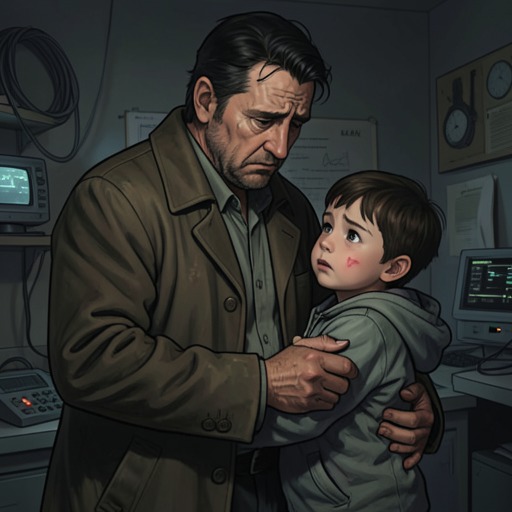
John–Linda mother-son relationship
Brave New WorldJohn and Linda’s mother-son relationship begins in the circumstances the World State treats as an intolerable breach of its reproductive order: Linda, once a Beta in the World State, gives birth to John in Malpais, far from the society she remembers. Their bond is real but strained by hardship, shame, and Linda’s recurring absence into intoxication or sleep. She also gives John his earliest education and his enduring image of the Other Place; when he returns to her bedside in London, that childhood inheritance meets a present in which she scarcely recognizes him. Her death leaves John grieving not only his mother, but also the idealized world she once described and the possibility of recovering their shared past.
Origins and displacement
Linda tells Bernard and Lenina that she came to the Reservation from the Other Place with the man she knew as John’s father. After she was injured in the mountains, hunters brought her to Malpais; the man left without her, and John was born there. Linda’s account identifies John’s father as Tomakin, the Director’s first name, making John’s parentage a revelation that connects their private family history to the World State’s institutions. For John, however, the immediate fact is simpler and more consequential: Linda is his mother, and the two of them are strangers in the place where they must live.
Their reunion with Bernard and Lenina exposes the distance between Linda’s past and her present. On seeing Lenina, Linda responds with relief at encountering a face and clothing from the society she remembers. She touches Lenina’s clothes and recalls the Malthusian Drill and the Abortion Centre, which she associates with her former life. Her own pregnancy was not, in her account, intentional: she says she followed the drill, yet gave birth, and Malpais offered no equivalent institution. John’s existence thus joins the two worlds Linda has been unable to reconcile: the reproductive control of the World State and the unplanned family life that followed her abandonment.
Childhood, care, and instruction
John’s childhood with Linda contains tenderness alongside instability. In one early memory, after they have eaten tortillas and sweet corn, Linda invites him to lie beside her and sings him to sleep with remembered songs from the Other Place. The scene gives their intimacy a domestic form, but the memories that follow also show how precarious their home life is. Linda sometimes stays in bed for days, sometimes drinks what Pope brings and falls asleep, and at times forgets to wash John or leaves him with little to eat. Her affection does not erase the neglect; the relationship is built from both the comfort she can offer and the needs she cannot reliably meet.
The children of Malpais mock John because of Linda’s reputation, and he responds by throwing stones when they sing about her. Their taunts make him an outsider among his peers, while Linda’s stories open an imaginative refuge. She tells him about flying, music, games, sensory pictures, clean houses, and a society where everyone is happy and belongs to everyone else. John listens for hours and preserves this account as a vision of the Other Place. Later, that vision will make the actual London he encounters difficult to accept: the remembered home was made intimate through Linda’s voice, even though it is not the same as the lived reality of the World State.
Linda also teaches John to read. She draws pictures and letters on a wall with charcoal, then gives him a thin instructional book for Beta embryo-store workers. John quickly learns the words, but rejects the book as a poor answer to the larger world of reading he imagines from Linda’s stories. When she later produces an old book from a chest, its unfamiliar language opens a different literary inheritance. These lessons make Linda more than the source of John’s longing for the Other Place: she is the person through whom he first encounters written language, even when what she can offer is limited and shaped by her own past.
Affection and conflict
The relationship’s strongest childhood rupture comes when John calls Linda his mother and tries to comfort her. Linda rejects the name, saying she will not be his mother, and slaps him. The exchange shows how the very bond that defines John’s place in Malpais can also be a source of shame and anger for Linda. Yet rejection is not the whole of their relationship: after another moment of distress, she embraces and kisses him. Their intimacy moves between injury and reassurance without resolving the conditions that make it unstable.
Linda’s dependence on what Pope brings further complicates their connection. John remembers her periods of drinking, sleeping, and illness; Linda, when she meets Lenina, recalls mescal and the absence of soma on the Reservation, and speaks of her shame at having had a child. These details are not simply a contrast between two places. They show how Linda’s longing for her former life and her difficulty living in Malpais shape the care she can give John. Her son grows up attached to the stories and affection she provides, while also witnessing her absences and the social hostility directed at them both.
Reunion and death in London
Years later, John sits beside Linda at the hospital and takes her hand, addressing her by name. Her recognition briefly brightens her eyes; she squeezes his hand and smiles before falling asleep. As he watches, John remembers her songs, her reading lessons, and the evenings when she told him about the Other Place. He still holds that remembered world intact, apart from the London around him, and his memories of Linda are bound to the promise of a happier, cleaner life she had described.
That moment of closeness does not last. Linda wakes to the hospital’s perfumed atmosphere and calls for Pope, then sinks back into her private soma dream. John pleads for her to recognize him, and she eventually does, but her awareness is caught up in the dream rather than in the present. As she struggles to breathe, John calls for help; when the nurse returns with him, Linda is dead. John falls beside the bed and sobs. The nurse, concerned that his grief will disturb the children’s death-conditioning, treats his visible mourning as a threat to their training. The scene makes the difference between mother and son especially stark: for John, Linda’s death is singular and devastating; around him, the institution expects death to be met without personal attachment.
Inheritance and significance
Linda’s effect on John persists beyond her death in two linked inheritances: the remembered Other Place and the experience of an individual bond that cannot be reduced to the World State’s social conventions. In a later discussion with Mustapha Mond, John condemns a society that removes suffering rather than learning to endure it. His thoughts return to Linda, who died while immersed in the pleasures of her soma holiday, and to the contrast between the life she had pictured for him and the World State he has encountered. Her death thus sharpens his criticism of a system that offers relief from pain at the cost of presence and attachment.
The relationship also stands against the society’s preference for standardized, replaceable human beings. The Director presents the Bokanovsky process as a means of producing uniform groups that stabilize society; John’s memories, by contrast, insist on the irreplaceable particularity of one mother, one childhood, and one death. At Linda’s bedside, John grieves the person the hospital’s conditioning teaches its children not to mourn. The bond is neither idealized nor uncomplicated: it includes care, neglect, shame, and conflict. Its force comes from that mixture, and from the fact that John’s memories of Linda remain personal in a world designed to make personal attachment seem unnecessary.